
VENDÉE GLOBE
Vendée Globe: The Cape Horn Dual Slalom?
redazione
When the leaders are due to round there are expected to be 15 relatively small icebergs to the south and east of Cape Horn at a radius of about 50 miles. The ice is reckoned to be drifting away at a rate of around 20 miles per day which, suggests Race Director Denis Horeau, means the problem is most serious for the first boats. Horeau told Vendée Globe LIVE today: “The choice is now with the skippers. We will inform them every day of the situation, what we can see with the satellites and what the drift is expected to be. So we will provide them with a report every day in order that they can understand the situation as well as we can see it.” The bergs which are seen by the satellites are between 100m and 400m long, but the problem for the skippers is the smaller sections which almost certainly exist, some of which will be semi-submerged. By comparison there were significant levels of ice in the East Pacific during the last edition in 2008-9, much of it well before the longitude of Cape Horn. Then, the Pacific East gate was moved more than 400 miles to the north to keep the fleet as clear of danger as possible. Closer Jean-Pierre Dick, in third is in a much better place than he was on Christmas Eve. He will now feel much more in touch with the two leaders, who sail VPLP-Verdier designs which are very similar to his Virbac-Paprec 3. At 371 miles behind Macif this afternoon, JP should pass Cape Horn less than 24 hours behind. The gains which he has made over the last few days have not just stabilised but in fact he has lost some 30 miles now that Gabart and Le Cléac’h are back up making between 17 and 19kts this afternoon after their 48 hours slow down. Thomson still finding it tough That said the desire to get clear of the Pacific is equally shared further back down the fleet. Alex Thomson from Hugo Boss, in fourth at 895 miles behind the leader reported again how tough he is finding the conditions with big seas, and very gusty winds:
“ CLS our partners have seen by satellite that there is ice drifting in the south and east of Cape Horn, but of course the problem is that the satellites can only see some of the ice, not all of it. So far we can only see ice by satellite which is at least 100 metres long. And so long as we know that there is ice of 100 metres long approximately then you can be sure that there will be some smaller bergs around. So that is our problem.”
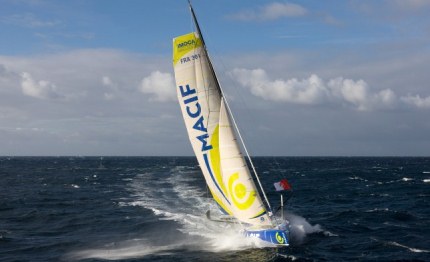
The two leaders are back in close contact with one another. After Francois Gabart took the lead again this morning, the 19th time that the baton has been exchanged between the Macif and Banque Populaire, the gap opened to six miles during the day but on the 1500hrs UTC ranking Gabart is only one mile ahead. The duration and closeness of their dual is on this race is largely unprecedented in solo ocean racing and there is an expectation that they can pass Cape Horn a matter of tens of minutes apart. What is perhaps most amazing is that the duo have had no significant, known breakdowns.
All of the top trio are eagerly anticipating their safe passage from the Big South into the Atlantic. But all will have already previewed the weather expected in the South Atlantic and it is not looking very easy with a succession of low pressure systems set to spin off the South American continent.
"I am very, very tired. I can not sleep, the wind is too unstable, I have to trim the time, "he wrote this morning. And the same level of fatigue and stress is maybe getting to Jean Le Cam who also hade 30 knots and was under pressure during the Vendée Globe LIVE communication which he had to abandon temporarily to keep SynerCiel upright:
“It is hard, hard, hard.” Said Le Cam.
On this 49th day of racing, only Mike Golding (Gamesa) and Dominique Wavre (Mirabaud) have been in relatively comfortable conditions, on the southern edge of an anticyclone.
29/12/2012 19:41:00 © riproduzione riservata
Tweet
 ARTICOLI
CORRELATI
I PIU' LETTIDELLA SETTIMANA
Route du Rhum: Ambrogio Beccaria pronto a sfidare l'Oceano
Ambrogio Beccaria: una seconda Route du Rhum, la prima in IMOCA a bordo di “Allagrande Mapei”
Concluso a Malcesine il primo Campionato Italiano Classi Foil
La pioggia non ferma le regate: mattina e pomeriggio, programma completo. La cerimonia di premiazione e chiusura: tutti i titoli italiani e i podi
Vele Storiche Viareggio 2026, i vincitori del 21° Raduno
Conclusa a Viareggio la ventunesima edizione del Raduno Vele Storiche Viareggio, organizzato dall’associazione presieduta da Gianni Fernandes, insieme al Club Nautico Versilia guidato dall’Amm. Ispett. Capo (Cp) Marco Brusco
Conclusa l'edizione 41 della Coppa Italia UVAI Trofeo MAG
COPPA ITALIA UVAI 2026 Trofeo MAG. Vittoria del First 35 South Kensington di Massimo Licata d’Andrea. Al C.C. Aniene per il secondo anno consecutivo la Coppa Italia UVAI per Circoli
Rolex Middle Sea Race, Black Jack 100 conquista la Line Honours
Il maxi di Remon Vos chiude le 606 miglia in 51 ore, 51 minuti e 50 secondi. Intanto prosegue la sfida per la classifica IRC, con Django 7X e Balthasar ancora in lotta.
Con la "Veleziana" la vela paralimpica nel cuore di Venezia
Sono stati dodici gli Hansa 303 in acqua e la vittoria è andata a Silvia Ragni e Paolo Casasola del Vela Club Levanto
America’s Cup: La Roche-Posay vara a Napoli il suo AC75
A soli 215 giorni dall’inizio della Louis Vuitton 38a America’s Cup, La Roche-Posay Racing Team, in rappresentanza della Société Nautique de Saint-Tropez, è diventato il primo team a varare un AC75 e a navigare nel Golfo di Napoli
Rolex Middle Sea Race, Django 7X batte Balthasar: vittoria in IRC 1 per l’Italia
Giovanni Lombardi Stronati e il tattico Vasco Vascotto protagonisti di un duello serrato lungo 606 miglia. Daguet 5 passa al comando della IRC 2, mentre resta aperta la corsa alla vittoria assoluta in compensato
America's Cup: ARC Team USA si rafforza, arrivano Annie Haeger e Ben Rosenberg
La velista olimpica di Rio 2016 e il giovane talento di Newport entrano nel gruppo che prepara la campagna americana per Napoli. Rosenberg avrà anche un ruolo nell'analisi delle prestazioni, mentre il team annuncia nuove novità in vista del varo dell'AC75
Napoli: una grande prima giornata al CICO 2026
Primo giorno ricco di vento e regate al Campionato Italiano delle Classi Olimpiche Edison Next (CICO) di Napoli 2026 che riunisce 347 barche e 399 velisti delle dieci discipline olimpiche e di tre classi Para Sailing