PRESS
Transat Bakerly: François Gabart making quick progress west
redazione
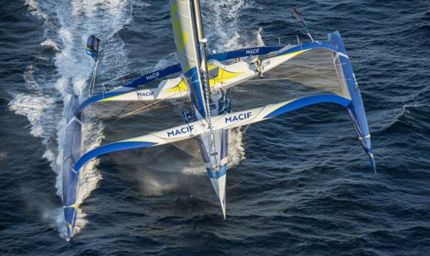
François Gabart instantly got down to serious racing for his first single-handed race at the helm of the MACIF trimaran, running down the Channel at full speed. This enabled him to measure the potential of his 30-metre multihull. "I didn't have time to hesitate. I crossed the Channel 50% of the time on one float. The central hull didn't touch the water often! I was able to run her at top speeds, since the wind was fairly regular and there was little swell, even if I constantly had my hands on the sheets." The skipper liked how the race started: "The first single-handed sailing emotions are very strong. It is the first time that I have been alone on the Atlantic, since the Route du Rhum. This is not without significance, particularly when you find yourself on a 30-metre trimaran. You cannot be indifferent". Before leaving Plymouth, François Gabart chose to set a southern course: "I knew that I would get as far as Cape Finisterre at least, because the Azores anticyclone was positioned fairly high up. This route allowed me to sail quickly downwind down the Bay of Biscay and to slip under the high pressure area. The northern route, which was quicker, was unthinkable with 40 knots wind speed and 10-metre waves." The MACIF trimaran is now making headway to the Azores, often sailing at over 30 knots. She will have to tackle the high-pressure, followed by a large low pressure area before she reaches New York. Constantly in contact with his router, Jean-Yves Bernot, the skipper is happy with these tactics. "As I like to anticipate, I do my weather routing from the boat, but it's always comforting to have someone to back me up on shore, giving me all the options. This saves time." Although the weather conditions favour speed right now, they are still quite difficult, due to the rough seas, which mean that François Gabart has to be particularly vigilant. He must also stay at the helm. "There are a lot of waves. It's a little tricky. You have to stay alert. You spend your time catching up with the waves and then there's a moment when there's one that's a little higher and it stops you in your passage. Yesterday, sailing round Cape Finisterre, there was a lot of wind and waves, so I spend hours steering." Does he still have time to rest? "Yes, I've managed to sleep well since the start. I have my own organisation between holding the sheets, the alarms and always keeping an eye open. You need to stay clear-headed on this kind of boat. You cannot allow yourself to lose sleep. So it's essential to find the time to rest, by taking successive naps. On average, I sleep between 3 and 5 hours per 24-hour stretch." The same requirements are also true for food, which must not be neglected, particularly when consuming so much energy in manoeuvres. This is the case for the skipper, who was gybing for the seventh time since the Bay of Biscay, on Wednesday morning. "Gybing takes a long time, is tiresome and occupies you. You turn cranks for 20 minutes and this cannot be reduced. You consume a lot of energy, so it's vital to eat properly." Since the start, François Gabart and Thomas Coville have been at close quarters, following more or less the same trajectory, so that MACIF's skipper was practically able to follow his contender on the AIS (radar) all night. "Being at such close quarters after two days of racing is remarkable. Having Thomas so close to the MACIF trimaran naturally encourages me to push harder. You don't want do ease up. The race also drives you to surpass yourself and find solutions to win the odd knot here and there. Thanks to the rankings and occasionally the AIS, I immediately know makes the boat perform better. It's a great way to make progress."
04/05/2016 19:46:00 © riproduzione riservata
Tweet
 ARTICOLI
CORRELATI
I PIU' LETTIDELLA SETTIMANA
Porto Cervo: poco vento e tanto sole per la prima della Rolex Swan Cup
La 23ª Rolex Swan Cup è iniziata a Porto Cervo con una flotta record di 170 imbarcazioni, riunite dallo Yacht Club Costa Smeralda per celebrare anche il 60° anniversario del cantiere Nautor Swan
Norwegian Aura, omaggio a Whitney Houston
Norwegian Cruise Line ha svelato l’offerta di intrattenimento di Norwegian Aura, la nuova nave che debutterà nel maggio 2027 e che avrà come spettacolo di punta Whitney: A Celebration of Whitney Houston
Salone Genova: l'industria nautica da diporto apre nuove rotte
Oltre 1.000 imbarcazioni, 215 novità e 45 Paesi: il 66° Salone Nautico intercetta l'evoluzione del mercato e rafforza la propria dimensione internazionale
Spirito corinzio e compleanni speciali al 21° Raduno Vele Storiche Viareggio
Dopo avere virato la boa del ventennale il Raduno Vele Storiche Viareggio riparte nel suo nuovo decennio con la ventunesima edizione di quello che è considerato il più importante evento dedicato allo yachting
Rolex Swan Cup:con il Maestrale spettacolo assicurato
Domani giornata conclusiva e classifiche corte in quasi tutte le classi
Mini 6.50: conclusa la Regata delle Isole, ultima tappa del Campionato Italiano
Tra i Proto la vittoria è andata a Eva Luna di Giacomo Nicchitta, che correva in coppia con Carlo Levantino. Tra i Serie vittoria di Morgane di Francesco Renella e Tommaso Stella
Les Voiles de Saint-Tropez, 253 barche tra Maxi, classici e J Class
Dal 26 settembre al 4 ottobre Saint-Tropez torna a essere una delle capitali mondiali della vela con la 28ª edizione di Les Voiles de Saint-Tropez, organizzata dalla Société Nautique de Saint-Tropez
Rolex Swan Cup: "vela champagne" a Porto Cervo
Con il Maestrale le classi Swan One Design hanno svolto fino a tre prove a bastone. Le altre classi Swan hanno navigato in condizioni ottimali tra le isole dell’Arcipelago di La Maddalena
Barcolana: Nave Vespucci ospite d’onore e il Villaggio si espande al Borgo Teresiano
Dal 2 all’11 ottobre Trieste si prepara a vivere la 58ª edizione della Barcolana presented by Generali, con la Coppa d’Autunno in programma domenica 11 ottobre
Dragoni a Sanremo: quattro giornate di grande vela
Il team portoghese del Clube Naval de Cascais, Vilma, conquista la vittoria davanti a Tergeste dello Yacht Club Sanremo. Terzo posto per Mario Quaranta dello Yacht Club Imperia