
VENDEE GLOBE
Vendée Globe: Beyou diverts to Cape Verde with Keel Problems
redazione
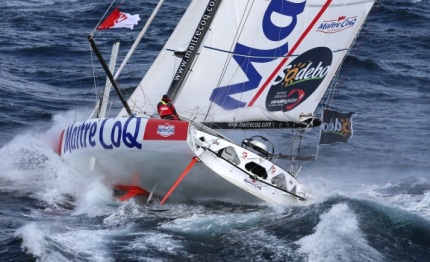
At 2300hrs (French time) on Saturday, Jérémie Beyou (Maître CoQ) detected a malfunction of the hydraulic jack of his keel. He has taken advantage of the proximity of Cape Verde for shelter in order to inspect in more detail the system that allows the keel to move.
When Beyou warned his crew shortly before midnight, he was 70 miles (130 km) from the Cape Verde archipelago and making five knots. He should have found shelter among the islands by midday on Sunday.
Meanwhile Zbigniew 'Gutek' Gutkowski (ENERGA) has heaved to, 500 west of the Canary Islands at the back of the fleet, waiting for the right moment to climb the mast and cutaway the gennaker wrapped around his forestay.
It is part of an ongoing struggle with his autopilot that has plagued him from the start. The 39-year-old Polish skipper came to a stop last night and was waiting for the wind to drop and swell to decrease, but his mission will be more perilous than Javier Sansó’s on Friday night, who was able to divert to Tenerife and find shelter in the lee of the island.
“The main thing is to get down the wrapped gennaker from the forestay,” Gutek said. “I have a sort of plan now how to do it but it’s not so easy. One way is to go up and then slide down cutting all into pieces, but these pieces could possibly hit the mast and I don’t want to lose the mast while actually being up on it. The better solution is to wait for the calm.”
“Cutting the halyard is not a solution, because all is well wrapped there. So now I am focused only on sorting out this problem, and after that I will think what next.”
Gutek said he has not felt in danger and has an exit strategy if it impossible to solve the problem.
“It puts me in no danger, as the wind is dropping. I can sail like this, but only downwind and down wave preferably. The trick is to have the gennaker ‘balloons’ hidden behind the mainsail to not risk breaking the forestay.”
“The closest (place to divert to) would be Madeira, Azores are also not so far away. But I would prefer Canaries, as there is the best infrastructure regarding transport and eventual repairs. I spent couple of months there and I know every marina, I could sail there without any map. But any decisions I will be taking after removing the sail from the forestay.”
Fleet news:
Bernard Stamm (Cheminées Poujoulat) has lost his second place and dropped down to fourth as he continues to register significantly slower speeds than the rest of the front six in the last 12 hours. As they drag race down the same corridor 800 miles from the Equator in 14 knot north easterlies, Stamm was making just 13.9 knots in the last hour before the 0400hrs ranking, compared to Jean-Pierre Dick (Virbac-Paprec 3), the fastest in the fleet, at 18.8 knots.
Dick moved into third place, 13 miles behind Francois Gabart (Macif), who is 62.6 miles behind the leader Armel Le Cléac’h (Banque Populaire).
One of the beauties of the Vendée Globe is waking to find out how the skippers fared between the last ranking of the night at 2000hrs (French time) and the first of the morning at 0500hrs. The English are often laughed at for playing a sport – cricket – in which games last five days. But the Vendée Globe is a game of strategy that plays out over 80-100 days (and much longer for some).
The skippers hold their cards close to their chest but the data tells a story. Something is slowing Stamm and likewise seventh-placed Jérémie Beyou (Maître CoQ), who lost 70 miles on the leader in the last eight hours and is crawling along at just 10 knots as he drifts away from the front six. AT 0900hrs (French time) that was explained by the damage to the hydraulic jack of his kanting keel.
Beyou had fallen back to Jean Le Cam (SynerCiel) who leads Mike Golding (Gamesa) by just 0.6 of a mile. Le Cam and Golding have now joined the rest of the fleet in the same corridor of fair wind south after almost match-racing each other to the east for seven days.
Alex Thomson (Hugo Boss) continues to impress in sixth, keeping pace with the leader overnight and biding his time just 123 miles behind. Thomson knows that the newer, lighter boats in front are faster in a drag race but is keeping in touch for when other qualities will be tested.
PHOTO JEAN MARIE LIOT
18/11/2012 14:01:00 © riproduzione riservata
Tweet
 ARTICOLI
CORRELATI
I PIU' LETTIDELLA SETTIMANA
Trieste: Arca SGR Marta 07 conquista la Line Honours nella costiera
Ad Arca SGR Marta 07 la Line Honours nella prova costiera della Settimana Velica Internazionale. Seven Seven primo tra gli ORC. Il finlandese Ponce vince tra gli ORC Double Handed
Rolex Swan Cup: tutti i vincitori
Porto Cervo ha salutato nel migliore dei modi gli oltre 1800 velisti presenti alla 23^ edizione della Rolex Swan Cup: una giornata perfetta di vela, sole e vento da Nordest che dagli otto nodi iniziali è arrivato fino a 12
America's Cup, collisione tra GB1 e il gommone Alinghi: danni al foil, Fletcher ferito
Protagonisti l’AC40 di GB1 e una chase boat di Tudor Team Alinghi, entrati in collisione mentre sul campo di regata si stavano preparando le prime partenze di prova
A Scarlino l'Act 5 conclusivo della RS21 Cup
Un appuntamento, quello dal 24 al 27 settembre, dalla duplice valenza: infatti verranno assegnati anche gli scudetti tricolore sia della Open che della Corinthian
ARC Team USA, a Napoli il debutto della nuova sfida americana
La 38ª America’s Cup entra nel vivo anche per ARC Team USA. A Napoli, dal 24 al 27 settembre, il nuovo challenger americano farà infatti il suo debutto agonistico nella Preliminary Regatta, prima occasione per vedere in gara l’equipaggio e l’AC40 del team
Il Lago Lemano ha offerto un duro banco di prova al Red Bull Italy SailGP Team
Il Red Bull Italy SailGP Team ha concluso il Rolex Switzerland Sail Grand Prix, undicesima tappa della Season 6 e ultimo appuntamento europeo del Rolex SailGP Championship prima delle due prove conclusive negli Emirati Arabi Uniti
Route du Rhum: al via ci saranno Francesca Clapcich e Ambrogio Beccaria
Il 1° novembre, da Saint-Malo, saranno 118 gli skipper che prenderanno il via della tredicesima edizione della grande transatlantica in solitario, destinata a concludersi dopo 3.542 miglia a Pointe-à-Pitre, in Guadalupa
ChioggiaVela 2026, cala il sipario sulla XV edizione
Si chiude con un bilancio particolarmente positivo la XV edizione di ChioggiaVela, che nel weekend conclusivo ha portato ancora una volta la vela nel cuore della città, coinvolgendo equipaggi, giovani atleti, appassionati e pubblico
Alinghi: in Vespa per adeguarsi all'Italian Style
Pietro Sibello guida i magnifici quattro di Alinghi: con lui il britannico Paul Goodison, skipper e timoniere di dritta, il neozelandese Phil Robertson, timoniere di sinistra, e lo svizzero Nicolas Rolaz, trimmer di dritta
Il Galata Museo del Mare per il Salone Nautico di Genova
Tariffe speciali per i visitatori della 66ª edizione del Salone Nautico Internazionale per scoprire le collezioni permanenti e le esposizioni temporanee del Museo. Il 3 ottobre gli Incontri in Blu portano al Salone una serata dedicata all’America’s Cup