MAXI YACHT ROLEX CUP
Maxi Rolex Boat Show: a collaborative process
redazione
With the range of concepts and solutions on display, it is little surprise that many Maxi projects are born at or inspired by the Maxi Yacht Rolex Cup. “Coming to an event like this you see so many different styles of boat,” explains Pugh. “It is definitely very stimulating in terms of creativity.”
A case in point is the recent launch Bella Mente, a project born following conversations between Vrolijk and owner Hap Fauth at the 2010 Maxi Yacht Rolex Cup. Vrolijk admits though that at this level it takes more than a chat to get everything in place to start the design process: “By trust and through discussions the owner commits to you. [His] team has a big influence in the type of boat you develop and how you can build it, where it is built, who is the project manager and who designs the sails, the mast. They will all have an influence on the design development.”
Fauth takes up the point: “Two years ago at the end of this regatta I sat down with Rolf Vrolijk and we started talking about the concept of doing a bifurcated design programme with two different hulls: an extension of the Rán family and perhaps a breakthrough hull. The process was developmental. We wanted to incorporate things we’d learnt from the last boat, including ideas in terms of layout and weight.” The result is Fauth’s hugely impressive 21.94m Mini Maxi which is leading at the halfway point this week.
As Pugh confirms, the design process is categorized by several key steps starting with the owner’s brief. “You will discuss the regattas the owner wants to do, how he wants the boat to perform on different race courses, whether it is long distance offshore races, transatlantic or a Maxi Yacht Rolex Cup, gaining an idea about where the boat has to win, where it has to have its strong points to meet his vision.”
Once commissioned, the research and development process can begin. “We will develop our best baseline design at that time after accumulating information such as weather and course data from where the boat is going to be racing primarily,” starts Pugh. “Sometimes we will tank test that baseline, other times we will test it through computational testing. Then we will develop a number of other designs that are slightly different, varying parameters of that baseline such as beam and displacement and different styles of hull shapes so we can run those over various race courses computationally. It is a fairly long process, taking somewhere between four to seven months.”
Once the design concept is finalised, the complex build process is set in motion, a collaboration involving composite structural engineers, together with sail and mast makers, and specialists in almost every conceivable aspect of a sailing boat. Pugh continues: “You start pre-engineering the design, figuring out where the boat is going to be built, the materials, the limits and, at that stage, you get involved in talking to a specific builder the owner would like to use.”
Once constructed the crew begin a further testing process through extensive sea trials and sailing the boat at its first competitive events. Exactly the position Bella Mente recently found herself in. Fauth continues: “It is a work in progress. You need to think what are the modes, how do we get there. It has taken the crew some time. Each day we look at the data and see if we are getting the kind of boat speed that the targets suggest.” Technology enables crews to crunch an amazing amount of data from cameras recording sail shape to sensors noting backstay and forestay tension. Of course, the data is nothing without skilled human interpretation. The sailors at the Maxi Yacht Rolex Cup are a who’s who in this regard, nearly all with a skill beyond simply knowing how to sail. “There is no other event where everyone is together, from crews to owners. It is a must to be here,” confirms Vrolijk.
Current trends
According to Pugh, the Mini Maxi class is the most prolific in terms of project activity, reflecting the desires of a highly competitive crop of owners that enjoy tight racing both inshore and offshore in similar size race boats, where advances in technology are incremental, but still allow for inspired vision. “The Mini Maxi class has some strict limits on the design criteria including fixed keels, but we are definitely going to see growth in this great size of boat.”
It is a trend that has delighted Mini Maxi owners. Two-time Mini Maxi Rolex World Champion Niklas Zennström welcomes Rán 2’s new competition: “Having four very similar 72-footers creates much more boat on boat racing, everyone has to sail better, leading to more tactical situations. That is what we love to do.”
Meanwhile, the Wally Cento is intended as a template design, and its first iteration, Hamilton, marks a significant shift in trends. Vrolijk explains the concept: “A new box rule has been developed by Wally in cooperation with ourselves and Reichel/Pugh. The idea is to have boats of a certain size, that are dual purpose, which means they are able to be used as a cruiser as well as a racer but with the maximum potential they can get out of this compromise.” Reichel/Pugh is working on a second Wally Cento in Magic Carpet 3, which will launch in 2013. The response to another owner taking advantage of stronger, lighter materials to improve speed. “It is a very exciting project,” continues Pugh, “It is not an absolute full race design but has to reach the class rules of considerable accommodation. This is an even bigger challenge than doing a stripped out racing boat.” She will launch in 2013, a response to another owner taking advantage of stronger, lighter materials to improve speed.
Tom Whidden, part of the Magic Carpet afterguard, a regular competitor at the Maxi Yacht Rolex Cup and a three-time America’s Cup winner, identifies where the design improvements in the concept lie and why: “The sterns are a little wider, the bows are a little finer, when the boats heel over the effective waterline gets longer and the sails are more exotic and faster, so the boats really get up and go. The older style of boat may go along on a reach between 11 and 15 knots in a good breeze. These new boats can go 20 knots. The trend is leading us in this direction because the materials and designs are better and the racing rules have led us to faster reaching boats.”
Eyes have also feasted on the 66.00m goliath Hetairos (CY), the largest boat ever to compete at the Maxi Yacht Rolex Cup, and which recently became the tallest vessel to navigate the Panama canal. “We developed the surface geometrics, the hull lines, the appendages and the sail plan,” says Pugh. “It is a high performance cruising yacht that has got an incredible cruising interior. The owner had a vision for a classic yacht that would be built as high tech as possible.” She is in good company with the 35m Firefly (NED) – another marriage of classic look and cutting-edge elements – tackling the same scenic courses.
Evolution not revolution
Is what we see in 2012 likely to set a pattern for the coming years? “There are parameters that limit you so you are not going to see an revolution in design,” warns Pugh. “But you may see a continuing evolution in hull design in terms of performance, and in sail plans and in rigs.”
Typically within the racing classes there is at any one time a ‘model design’, such as Zennström’s Mini Maxi racer Rán 2. “You’ll look at what the hot designs are doing and how they perform,” admits Pugh. “However, you’ve also got to look forward as they are always getting faster. There is plenty of room for evolution in design development.”
The cruiser/racer boats – prevalent across all scales of Maxi yacht – provide designers with plentiful and interesting challenges, as noted in the case of Hetairos. While performance is compromised when accommodating various interior requirements, there is no lack of solutions available in the search to maximize speed potential. On larger cruising boats volume and interior fittings increase weight and loads; consequently power from the sails needs to be maximized, with rigging and control systems needing to handle bigger strains. Whilst there may be nothing truly radical ahead in terms of hull shape, the other component parts of both racing and cruising boats will evolve as research discovers new ways to answer old problems.
“The possibilities are always there,” adds Vrolijk “and a desire to push the boundaries of speed will always be prevalent. For every generation of boats, the new ones have to be faster,” closes Vrolijk. “That means there’s always pressure on you. When the boats finally start racing against each other, you hope to see the progress in design.”
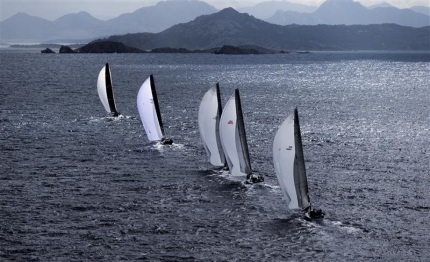
As certain as Maxis will continue to break boundaries, the Maxi Yacht Rolex Cup will forever be the proving ground for the world’s greatest and fastest yachts.
Photo Credit: Carlo Borlenghi
07/09/2012 11:18:00 © riproduzione riservata
Tweet
 ARTICOLI
CORRELATI
I PIU' LETTIDELLA SETTIMANA
Trieste: Arca SGR Marta 07 conquista la Line Honours nella costiera
Ad Arca SGR Marta 07 la Line Honours nella prova costiera della Settimana Velica Internazionale. Seven Seven primo tra gli ORC. Il finlandese Ponce vince tra gli ORC Double Handed
Rolex Swan Cup: tutti i vincitori
Porto Cervo ha salutato nel migliore dei modi gli oltre 1800 velisti presenti alla 23^ edizione della Rolex Swan Cup: una giornata perfetta di vela, sole e vento da Nordest che dagli otto nodi iniziali è arrivato fino a 12
America's Cup, collisione tra GB1 e il gommone Alinghi: danni al foil, Fletcher ferito
Protagonisti l’AC40 di GB1 e una chase boat di Tudor Team Alinghi, entrati in collisione mentre sul campo di regata si stavano preparando le prime partenze di prova
A Scarlino l'Act 5 conclusivo della RS21 Cup
Un appuntamento, quello dal 24 al 27 settembre, dalla duplice valenza: infatti verranno assegnati anche gli scudetti tricolore sia della Open che della Corinthian
ARC Team USA, a Napoli il debutto della nuova sfida americana
La 38ª America’s Cup entra nel vivo anche per ARC Team USA. A Napoli, dal 24 al 27 settembre, il nuovo challenger americano farà infatti il suo debutto agonistico nella Preliminary Regatta, prima occasione per vedere in gara l’equipaggio e l’AC40 del team
Il Lago Lemano ha offerto un duro banco di prova al Red Bull Italy SailGP Team
Il Red Bull Italy SailGP Team ha concluso il Rolex Switzerland Sail Grand Prix, undicesima tappa della Season 6 e ultimo appuntamento europeo del Rolex SailGP Championship prima delle due prove conclusive negli Emirati Arabi Uniti
Route du Rhum: al via ci saranno Francesca Clapcich e Ambrogio Beccaria
Il 1° novembre, da Saint-Malo, saranno 118 gli skipper che prenderanno il via della tredicesima edizione della grande transatlantica in solitario, destinata a concludersi dopo 3.542 miglia a Pointe-à-Pitre, in Guadalupa
ChioggiaVela 2026, cala il sipario sulla XV edizione
Si chiude con un bilancio particolarmente positivo la XV edizione di ChioggiaVela, che nel weekend conclusivo ha portato ancora una volta la vela nel cuore della città, coinvolgendo equipaggi, giovani atleti, appassionati e pubblico
Alinghi: in Vespa per adeguarsi all'Italian Style
Pietro Sibello guida i magnifici quattro di Alinghi: con lui il britannico Paul Goodison, skipper e timoniere di dritta, il neozelandese Phil Robertson, timoniere di sinistra, e lo svizzero Nicolas Rolaz, trimmer di dritta
Il Galata Museo del Mare per il Salone Nautico di Genova
Tariffe speciali per i visitatori della 66ª edizione del Salone Nautico Internazionale per scoprire le collezioni permanenti e le esposizioni temporanee del Museo. Il 3 ottobre gli Incontri in Blu portano al Salone una serata dedicata all’America’s Cup